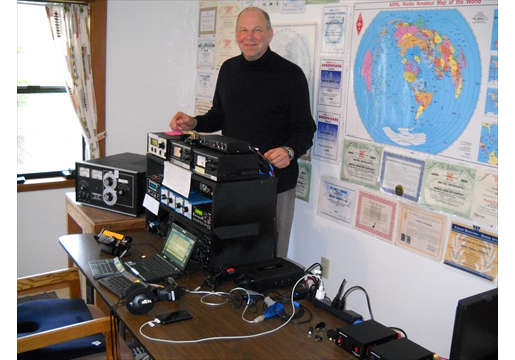
If you've ever had thoughts about building a remote contest station, this article may provide some additional food for thought to guide your decision-making and planning - whether for an SO2R or a traditional SO1R venue. It's my sincere hope to keep you from making the sorts of costly mistakes I have made to date in my seemingly never-ending project - the solar/battery powered Locust Peak SO2R remote contest stations.
Proverbial Questions
To paraphrase Shakespeare, "To remote or not to remote, that is the question." Another age old adage also applies: "Everything always takes longer and costs more than expected." Just how expansive your new remote station setup will be depends upon the size of your dreams, the amount of effort and time you are willing to expend, and of course, the "B" word, budget. If you need any bulldozing or tractor work done, I suggest you look into the costs now!
The $128,000 question is will your remote station be strictly remote controlled or will you (or do you want to be able to) operate from the remote site in-person, weather permitting. For me, it was the latter. The new, almost-completed mini-barn shack has a window over the built-in operating desk offering a scenic view that includes the nearby reservoir.
Thanks to some pretty amazing technological developments, remote station contesting is no longer a pipe dream, and it's potentially affordable to all at some level. The Internet has facilitated many new remote stations. The nasty "L" word (latency) still poses some challenges, however, especially for QRQ CW contesters. My objective was to realize a 5 ms or less latency factor, so I was exuberant to end up with a very low 1 ms (I'll share in Part 2 of this article how this was miraculously accomplished).
What follows are some important things to consider before deciding to embark on a remote station adventure (although for me it's been more like a bad horror movie at times, due to perpetual road repair issues).
Purchase vs Rent or Lease
Nowhere is it written in stone that one must purchase land in order to implement a remote contest station. Ownership provides greater control over circumstances, however. If purchasing is not in your budget, though, consider locating a workable site and entering into a rent or lease agreement. This contract should be prepared by a competent real estate attorney who fully understands your needs, your investment of time and money and your best guesstimates to identify future "what if" scenarios that may need to be addressed.
You may know an old friend, work associate or even a relative with a possible location with whom you could work out some type of arrangement. Even a remote tri-bander painted stealth green to blend in with the trees and a few wire antennas are much more competitive than a single attic dipole in a condo.
24/7/52 Paved Road Access
Access is one of the most important aspects, and it's an even more critical factor if you are in an area of the country that experiences severe winter weather. If the remote site is in a high fire risk area, make sure there is more than one means of ingress and egress. You may even want to re-think your interest in such a property. Unfortunately, I did not, since the Locust Peak property is family-owned land and my tunnel vision was focused upon eventually seeing many antennas along the 1400 foot ridgeline. I failed to give ample consideration to potential (and perpetual) road problems. Indeed, these have hindered my ability to get up there during inclement weather, although the problems should have been obvious from the start. Having only one means of ingress and egress at Locust Peak does not give me the warm fuzzies, especially after some close calls during the last two fire seasons.
As Figure 2 shows, the historic washout area on the very lower part of what becomes a steep, winding, mile-long dirt road up the mountain should also have been a clue to problems ahead. I ended up installing a two-foot diameter culvert and deploying countless sacks of concrete and rebar to reinforce this part of the road. The time I spent doing this work alone could have been more constructively devoted to putting up more antennas. The road's condition should have been a big red flag prompting me to run in the opposite direction before beginning costly bulldozing and other road repairs just to get to the site. In short, the Locust Peak road has been the source of never-ending trouble and travail.
For the complete version of this article as published in the NCJ, view the PDF version.